
Dominando a arte de costurar um cós elástico: um guia passo a passo
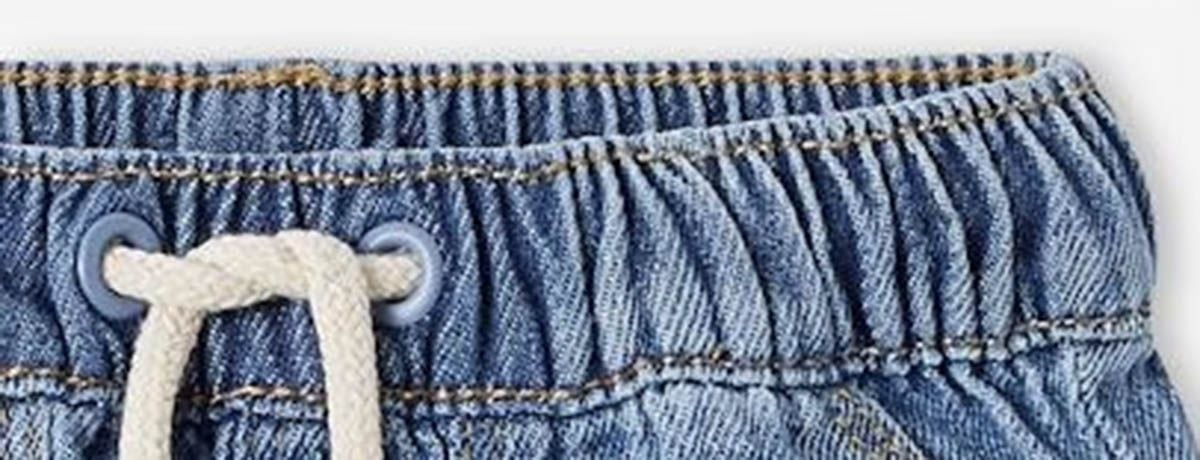
An elasticated waistband is a waistline finished with elastic — braided, knitted, or woven — enclosed in or stitched to a fabric casing so the garment stretches to fit and recovers to shape.
Principais lições
- An elasticated waistband = elastic + casing; the elastic type (braided / knitted / woven) drives comfort and durability.
- Braided narrows under stretch (casing only); knitted stays soft and wide (sew-through, skin contact); woven is firm and heavy-duty.
- Match elastic to fabric weight: light fabric → knitted/braided; heavy fabric → woven.
- For sourcing, specify width (mm), elongation %, recovery, fiber blend (e.g., polyester/spandex ratio), and MOQ — not just “elastic”.
What Is an Elasticated Waistband?
An elasticated waistband is a waistline finished with elastic enclosed in or stitched to a fabric casing, giving garments comfort, a flexible fit, shape recovery, and less restriction around the waist while still staying secure across a range of body types. It also makes garments easier to pull on and off and allows freer movement for bending, walking, and stretching. That is why it appears in pants, skirts, shorts, activewear, sleepwear, childrenswear, and in practical settings such as physical activity, long journeys, and maternity wear. Depending on the garment, it can also create a smoother silhouette under fitted tops. Functionally, it comes in two main construction families:
-
Fold-down (self) casing — the garment's own waistline fabric allowance is folded to the inside and stitched down to form a tunnel for the elastic.
-
Applied casing — a separate strip of fabric (or a pre-made trouser waistband) is attached to the waistline to hold the elastic.
For garment manufacturers, wholesalers, sewing professionals, and buyers, the construction choice affects labor time, bulk consistency, garment comfort, durability, and cost per unit: fold-down casings save on a separate component, while applied casings and pre-made waistbands speed up production lines and hold width tolerance better across large runs. This guide explains how elasticated waistbands are built, the main elastic types used—braided, knitted, and woven—common waistband styles, sewing methods, sourcing considerations, and the key questions to check before production or purchase, especially when working with a leading global garment accessories supplier.
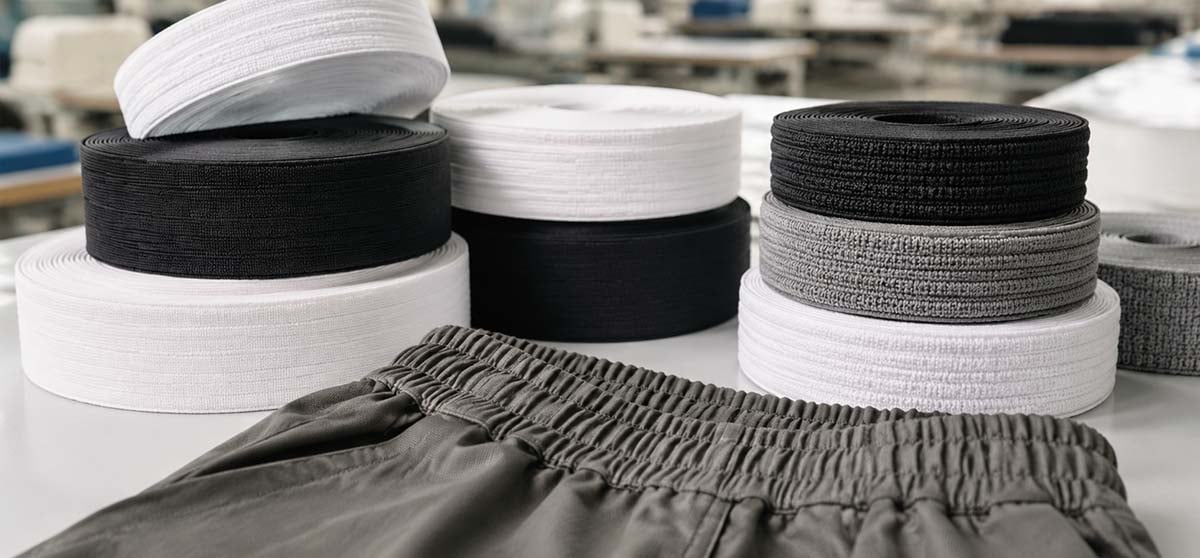
Which Elastic Type Should You Choose? (Braided vs Knitted vs Woven)
The single most important sourcing decision is the elastic itself. Braided, knitted, and woven elastics behave differently under stretch and suit different fabric weights. Choosing correctly upfront prevents the two most common defects in elasticated garments: waistbands that curl/roll and waistbands that lose recovery after washing.
| Tipo elástico | Behavior under stretch | Feel / best fabric weight | Sew directly? | Common B2B use |
|---|---|---|---|---|
| Elástico trançado | Estreita quando esticada | Firm, light–medium fabric | No — casing only | Cuffs, light waist casings, budget lines |
| Elástico de malha | Keeps width when stretched | Soft, light–medium fabric | Sim | Skin-contact waistbands, activewear, kidswear |
| Woven (non-roll) elastic | Keeps width, very stable | Firm/strong, heavy fabric | Sim | Roupa exterior, heavy support bands, workwear |
Regra prática para compradores: pair lightweight fabric with knitted or braided elastic, and pair sturdier fabric with woven elastic. Knitted elastic is the safest default for direct skin contact because it stays soft and does not narrow; woven non-roll is the choice when the band must resist twisting under load. For stretch fabrics such as polyester/spandex knits, confirm the elastic's recovery matches the fabric so the two age at the same rate.
Waistband Construction Types (and When to Use Each)
Beyond the basic casing, several construction variations show up on production spec sheets. Each has a different look, labor cost, and end use.
| Construção | O que é isso | Look / benefit | Best-fit garment |
|---|---|---|---|
| Basic single casing | One tunnel, one elastic | Simplest, lowest cost | Basic pants, shorts, pull-on skirts |
| Revestimento duplo | Two parallel tunnels/elastics | Structured, controlled gathers | Dresses, refined skirts |
| Saco de papel | Casing set below a ruffled top edge | Volume + fashion detail | Trend pants/skirts |
| Drawstring hybrid | Elastic casing + drawstring exit | Adjustable, personalized fit | Joggers, casualwear, unisex |
-
Basic single casing is the workhorse for high-volume, price-sensitive orders, with enough room for comfort without making the waist feel tight or overly loose.
-
Revestimento duplo sews a second parallel tunnel beneath the first for a more structured waist and separate fit control.
-
Saco de papel cuts the top section wider so fabric ruffles above the casing — a fashion detail that adds perceived value and can look more elegant than a basic casing in the right fabric, particularly when paired with lightweight chiffon dress fabric. The upper edge is cut wider, and a marked line is used to place the casing below the ruffle.
-
Drawstring hybrid reinforces grommets or buttonholes with interfacing and adds a cord for on-body adjustment; the drawstring is cut longer than the elastic so it can be tied. It reads more casual and works well with a t shirt rather than a more formal image.
Construction choice is also a design feature, and the brand may have decided between cleaner or more relaxed styling depending on the garment.
For example, a basic casing usually reads simpler, while a paperbag waist creates more visual interest.
What is popular at the moment may also affect which waistband construction a buyer chooses.
How to Sew a Basic Elasticated Waistband (Reference Method)
Whether your team runs this in-house or briefs a contractor, the standard sequence is worth having in a spec sheet and works well as a tutorial for repeatable garment projects:
-
Size the casing. Add elastic width + ease + seam allowance to the waistline measurement. Keep the casing at least ¼ inch (≈6 mm) wider than the elastic so it feeds evenly, then determine elastic length by measuring around the waist and cutting it 1 inch longer than that measurement.
-
Prepare the band. Sew side seams right sides together, press the raw edge under for a neat fold, then press again to the casing width, mark the casing line if needed, and pin.
-
Stitch the casing, leaving a small gap to insert the elastic; this stitching forms the entire casing, so keep it even and professional.
-
Thread the elastic. Attach a large pino de segurança or bodkin to one end and walk it through the casing without twisting; this can be tricky for beginners, so let the fabric hang flat as you feed it and notice right away if the elastic turns.
-
Join the ends. Overlap the elastic by about 1 inch (2.5 cm) and, as part of the process, sew back and forth to secure the join with stitching.
-
Close and finish. Stitch the gap closed, then topstitch flat in a straight line or parallel lines with the elastic pulled taut for a more professional finish and better durability, so the waistband will stand up to wear and wash. A serger, overlocker, or zig-zag gives a clean, durable edge.
Usar um ruler or tape measure and a sewing gauge to hold a consistent casing width across the run — width variance is the top cause of inconsistent waistbands in bulk production. For bulk orders, pair this with high-quality industrial linha de costura supply such as Linha de costura 50/2 em poliéster com núcleo fiado to keep seams durable and production-efficient. Add pins, a sewing machine, and the correct needle to your course of action for consistent construction.
Different makers will have a favourite method, but consistency matters most in bulk production and in garments with pockets.
Sourcing Elastic Waistbands & Tape from MH (Supplier Overview)
MH (Ningbo MH), established in 1999, supplies elastic tape, webbing, and trouser waistbands to buyers in 150+ countries. Para compradores B2B, isso significa:
- Lotes consistentes — braided, knitted, and woven elastics woven to repeatable width, elongation, and recovery across reorders.
- Materiais completos — pair elastic with matching trouser waistbands, thread, drawcord, and fabric from one source.
- Especificações personalizadas — type, width, elongation, fiber blend, and color to your production needs, MOQ agreed up front.
Ask any supplier for elastic type, width, elongation %, recovery, fiber blend, color, MOQ, and lead time in writing so you can compare like-for-like. If you are building pull-on trousers or activewear, confirm compatibility with your chosen shell cloth, whether that is a Tecido de malha elástica composto por 93% poliéster e 7% elastano. Tecido Maserati em poliéster e elastano com elasticidade em 4 direções..
Browse the garment webbing & waistband range →

Perguntas frequentes
Que tipo de elástico devo usar para tecidos leves? For lightweight fabrics, use braided or knitted elastic — both give a gentle stretch without adding bulk. Knitted elastic is preferred for skin contact because it stays soft and keeps its width when stretched, while braided works well inside a casing on budget-sensitive lines.
What is the difference between braided, knitted, and woven elastic? Braided elastic narrows when stretched and should be used inside a casing only. Knitted elastic keeps its width, stays soft, and can be sewn directly to fabric. Woven (non-roll) elastic is the firmest and most stable, best for heavier fabrics and support bands where the waistband must resist twisting.
How do I ensure an elastic waistband has even tension? Cut the casing at least ¼ inch (≈6 mm) wider than the elastic, thread the elastic without twisting, and distribute the fabric evenly along its length before joining the ends. If the fit is correct, a phone or other small item should not pull the waistband out of place during normal wear. Topstitching the band flat also prevents twisting in wear.
Can garments with elasticated waistbands be tumble-dried? Air-drying is strongly preferred. High dryer heat weakens elastic fibers and reduces recovery over time, so waistbands lose their shape faster. Cold wash, no bleach, no fabric softener, and do not iron also extend elastic life.
What information does a supplier need to quote an elastic waistband? Specify elastic type (braided/knitted/woven), width, elongation %, recovery, fiber blend (such as the polyester/spandex ratio), color, MOQ, and lead time. Providing these upfront lets a supplier like MH quote accurately and hold consistent lots across reorders.
